
You’ve felt it before.
That strong, minty, almost burning “clean” feeling after using mouthwash.
It feels powerful.
It feels effective.
It feels like your mouth is finally germ-free.
But here’s the truth:
That sensation might be doing more harm than good.
The Biggest Misconception About Oral Health
For years, oral health has been simplified into one idea:
Kill bacteria to stay healthy.
So naturally, people:
- Use antibacterial mouthwash every day
- Choose the strongest “germ-killing” products
- Try to eliminate bacteria completely
It sounds logical, but it is incomplete.
Your mouth is not meant to be sterile.
Your Mouth Is a Living Ecosystem
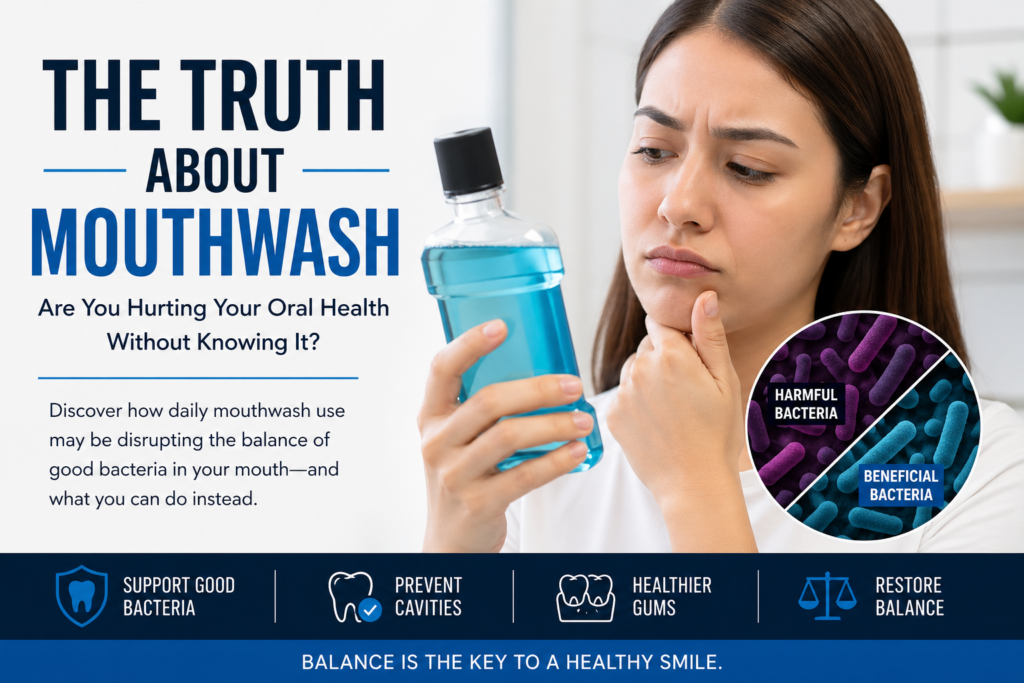
Your mouth is home to millions of bacteria, and not all of them are harmful.
There are:
- Harmful bacteria that contribute to cavities and gum disease
- Beneficial bacteria that help protect your teeth and gums
When you use strong antiseptic mouthwash daily, it does not only target harmful bacteria.
It also removes beneficial bacteria.
This disrupts the natural balance of your oral microbiome.
Once that balance is compromised, problems begin to appear.
“I Brush and Floss Every Day… Why Do I Still Get Cavities?”
At West Covina Smiles, this is one of the most common concerns we hear.
Patients who follow proper routines still experience:
- Recurring cavities
- Gum sensitivity or inflammation
- Dental treatments that do not last as expected
The missing factor is not just cleanliness.
It is balance.
You can have clean teeth and still have an unhealthy oral environment.
Dentistry Is Evolving
Modern dentistry is shifting away from the idea of eliminating all bacteria.
The focus today is on managing and stabilizing the oral environment.
Instead of:
Old approach: eliminate all bacteria
New approach: control harmful bacteria and support beneficial ones
When the right balance exists, your mouth is better equipped to protect itself.
Is Mouthwash Bad?
Mouthwash is not inherently bad.
However, daily use without a specific clinical reason may not be necessary.
Many antiseptic mouthwashes were designed for:
- Short-term therapeutic use
- Post-procedure care
- Specific gum conditions
They were not intended to be used indefinitely by everyone without guidance.
What You Can Do Starting Today
Improving your oral health does not require complicated changes.
1. Reevaluate Daily Mouthwash Use
If you use a strong antibacterial rinse every day, consider reducing frequency unless it has been recommended by your dentist.
2. Maintain Brushing and Flossing
These remain essential. The goal is not to replace them, but to enhance your overall approach.
3. Add Xylitol After Meals
Xylitol gum or mints can help reduce harmful bacteria, support saliva production, and maintain balance without disrupting the oral microbiome.
4. Consider Oral Probiotics
Oral probiotics may help reintroduce beneficial bacteria and support a more stable environment in your mouth.
Why This Matters
If your goal is to:
- Prevent cavities
- Avoid gum disease
- Protect long-term dental work such as crowns, veneers, or implants
Then maintaining a balanced oral environment is essential.
Even high-quality dental treatments can fail if the underlying conditions are not addressed.
The Bottom Line
That burning, “clean” feeling from mouthwash does not necessarily mean your mouth is healthier.
True oral health is not about eliminating all bacteria.
It is about maintaining the right balance.
Schedule a Consultation
At West Covina Smiles, we take a comprehensive approach to dental care.
We focus on creating a stable oral environment that supports long-term results, not just temporary fixes.
If you want to prevent recurring issues and protect your smile over time, schedule a consultation today.